FinanceFlow — Personal Finance Tracker
A full-stack personal finance platform that lets users track expenses, categories, and reports, with a scalable FastAPI backend, Firestore storage, and a modern React frontend.
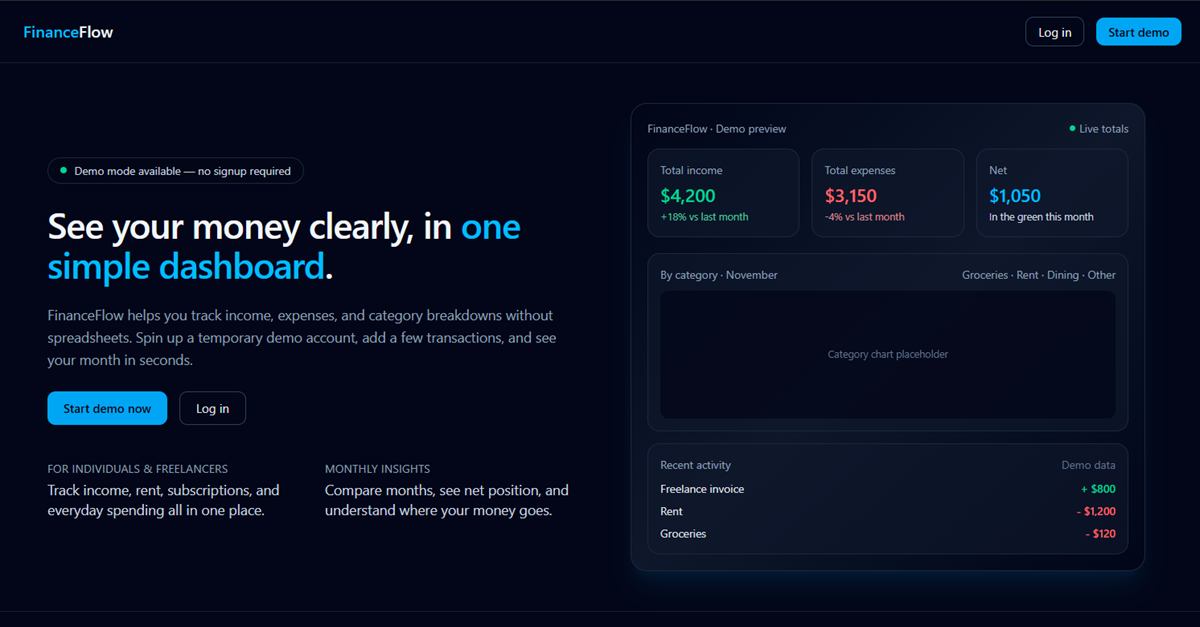




Project Brief
FinanceFlow is a full-stack personal finance tracker that helps users manage expenses, categories, budgets, and financial insights. It’s built with a production-style FastAPI backend, Firestore as the NoSQL database, and a React frontend, focusing on clean architecture, secure auth, and cloud deployment.
Project Duration (Estimate)
In progress; built part-time alongside internship and other projects.
Repositories
Approach
- Planning & Goals
- Defined the core workflow around tracking daily spending, categories, and summaries that actually help users see where their money goes.
- Designed the app to feel like a lightweight SaaS product, not a toy script.
- Planned for future features: budgets, recurring transactions, and insights dashboards.
- System Design & Architecture
- Backend: FastAPI with a clear layering: api/ → services/ → repos/ → models/.
- Database: Google Firestore (NoSQL) with user-scoped collections for categories and transactions.
- Auth: JWT-based authentication with support for demo users (no signup friction).
- Frontend: React + Vite with Axios API client and persistent auth token handling.
- Implementation Workflow
- Started from the data model: users, categories, transactions, and reports.
- Implemented REST APIs for CRUD on categories and transactions, plus reporting endpoints.
- Used Pydantic schemas for strict request/response validation and clear API contracts.
- Integrated the frontend with a centralized Axios instance and protected routes.
- Demo Mode & Onboarding
- Implemented a Demo Mode login that returns a short-lived JWT and demo user ID.
- On first demo login, auto-seeds default categories (Food, Rent, Transport, etc.).
- Creates sample transactions so users immediately see charts and tables populated.
- Deployment & Environments
- Containerized the backend with Docker for reproducible local and cloud runs.
- Deployed the API to Google Cloud Run using service accounts and env vars.
- Separated local vs production configs via environment variables (origins, keys, project IDs).
- Testing & Quality Assurance
- Smoke-tested core endpoints: auth, categories, transactions, and reports.
- Verified CORS behaviour between local frontend and Cloud Run backend.
- Manual UX walkthroughs: first-time demo user → add category → add transaction → view reports.
Features
- User Authentication: JWT-based auth with standard users and demo users.
- Categories: Create, edit, and delete expense categories linked to each user.
- Transactions: Add income/expense records with amount, date, and category.
- Reports & Summaries: Simple spending summaries by category and date range.
- Demo Mode: One-click demo login with pre-seeded data for instant exploration.
- Cloud-Hosted API: FastAPI backend running on Google Cloud Run.
- Secure API Integration: Axios client with token injection and CORS-safe configuration.
- Extensible Architecture: Service/repo pattern ready for future features like budgets and exports.
Tools & Technologies
PythonFastAPIPydanticGoogle FirestoreFirebase Admin SDKReactTypeScriptViteAxiosDockerGoogle Cloud RunGitGitHubLoguru